

Overview
Read this article from a comprehensive knowledge base, updated and supplemented with articles reviewed by scientific committees.
Read the articleAUTHOR
-
Georges HENRIOT : Arts et Métiers engineer - Former Technical General Manager of Engrenages et Réducteurs
INTRODUCTION
A gear is a device that connects two shafts, transmitting rotational motion from one of the shafts (the driving or motor shaft) to the other (the driven shaft), with a constant ratio of angular speeds.
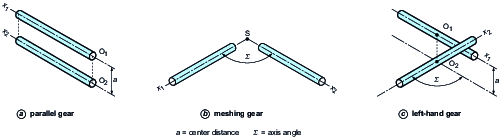
Depending on the relative position of the two shafts to each other, we have three main gear classes:
Parallel gears: the two axes are parallel (figure 1a).
Concurrent gearing: the two axes intersect along their extensions (figure 1b).
Left-hand gear: the two axes occupy any relative position; they are neither parallel nor intersecting (figure 1c).
This section on gears is made up of several articles.
The first two articles deal with parallel gears, the first being devoted to geometrical studies, the second to tooth corrections. .
In the following article, we'll be taking a closer look at left-hand and right-hand gears. and, in a fourth section, loads on gears and strength calculations. .
The final section deals with manufacturing methods and planetary gear trains. .

Exclusive to subscribers. 97% yet to be discovered!
Already subscribed? Log in!
Parallel gears - Geometric study
 General definitions
Exclusive to subscribers. 97% yet to be discovered!
Already subscribed? Log in!
Article included in this offer
"Mechanical functions and components"
(
219 articles
)
Updated and enriched with articles validated by our scientific committees
A set of exclusive tools to complement the resources
