
Plastics and composites
355 articles
Make the most of these materials with their high development and application potential
Techniques de l'Ingénieur provides access to the leading technical and scientific database. It enables users to quickly find reliable, comprehensive, and always up-to-date information. Validated by leading experts, it supports engineers and scientists from industry, design offices, and R&D centers in carrying out their projects.
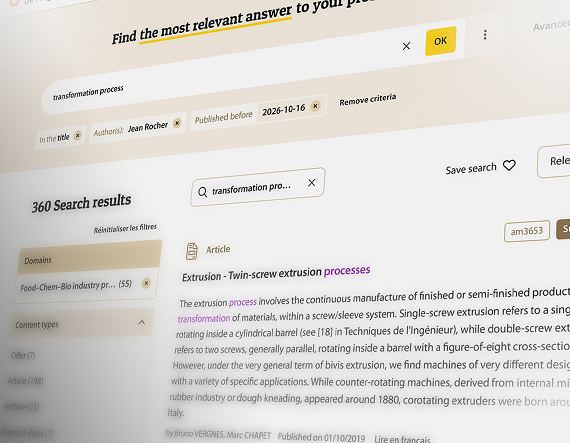
Each type of article meets a specific need (authoritative article, how-to sheet, video article, experience feedback article...) and is enriched with medias (quizzes, tables, visuals, illustrations, equations), bibliographic or economic data, and links to reference organizations or information on standards and patents.
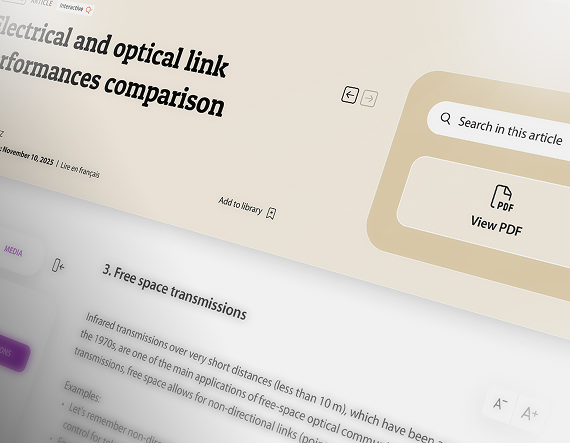
Each sector of activity and each profession has its own specific characteristics. Browse our areas of expertise, from materials to biotechnologies, mechanics and ICT, and discover offers adapted to your projects.
To stay permanently up to date!
Regular updates to our resources ensure always up-to-date information.
Managing work health and safety risks is a priority for companies and maintenance activities, which turn out to be very accident-prone, are particularly concerned. This article formalizes a method for analyzing and controlling occupational risks in maintenance by presenting the various technical steps to be implemented during the task preparation phase or during an overall risk assessment. It presents the phases of hazard identification, risk assessment and prioritization and search for risk control means by proposing solutions to have a complete and rigorous approach.
Optical parametric sources are versatile devices for efficiently generating tunable coherent radiation from an incident laser beam through a nonlinear optical process. This frequency conversion enables us to cover spectral ranges that are at best poorly covered by direct laser emission. This paper presents an overview of the optical parametric sources starting with their theoretical bases and their principles of implementation, and finally their use in a range of representative applications.
This article reviews different characterization methods for measuring the time profile of ultrashort laser pulses, with a typical duration ranging from a few femtoseconds to a few picoseconds. These methods can be either non-stationary or nonlinear. In the former case, a reference ultrashort pulse is usually used to access the unknown pulse profile by sampling or interferometry. In the latter case, a second- or third-order nonlinear optical process makes a self-referenced measurement possible, sometimes through the use of an iterative algorithm.
The equilibrium state of an electrochemical system is first described. The kinetics of an electrochemical reaction are then specifically addressed. The definitions of quantities commonly used in electrochemical kinetics are then given, together with their physical meaning and their main applications in electroanalysis, corrosion and industrial processes. The article is illustrated by a series of examples, and gives tables of experimental data useful for engineers. Lastly, the main experimental electrochemical techniques are described.
Zirconium and hafnium stand in the fourth column of the periodic table. Zirconium ore always contains about 2% hafnium. These metals were first developed for nuclear applications to exploit the neutron transparency of zirconium and the neutron absorption of hafnium. In this article, some of their physical and mechanical properties are presented. Their excellent corrosion resistance in numerous environments (except fluorinated or chlorinated), which permits their use in the chemical industry, is illustrated. A summary of their processing methods, close to that of titanium alloys, is given. They can be welded, but not to steel or most other materials. They can ignite very easily if finely divided into powders.
The article describes zirconium and hafnium metallurgy, made difficult and costly by the chemical stability of their oxide or silicate ores, and the need to separate the two metals, which occur intimately mixed. The extractive metallurgy processes that yield the metal are first described, then the vacuum arc re-melting process that leads to the alloy ingot, and lastly the subsequent processing steps: forging, extrusion, rolling or pilgering to obtain the desired geometrical shape, and properties, with intermediate heat treatments performed under vacuum or inert gas when product thickness is in the millimeter range. The main alloys are listed.
Unlike the EMC of components or electronic equipment, systems EMC presents specific features. Up to the final stage of qualification, it is important to master the definition of system and to work in successive phases. These stages are punctuated by specifications, analysis of correlations between EMC contributors, modeling and tests. In this article, we present specific aspects of EMC that we meet on a system, and the incremental approach in demonstration logic. Examples from the domain of space launchers are used to illustrate the different points raised.
The essential characteristic of high-frequency conductors is that they keep pace with the technological developments of materials in order to limit losses and miniaturize electronic devices. This requires a theoretical reassessment of transportation phenomena due to the introduction of nanotechnologies. Numerous applications are discussed within a more traditional context: in electromagnetic compatibility (EMC), circuits and planar lines, losses by radiation and use of quasi-optical techniques.
Optical fiber today replaces copper cables or twisted pairs in access networks in order to modernize operators' networks. As a result, customer data rates are evolving towards very high-speed broadband of around one gigabit per second or more. This article aims to provide an overview of solutions standardized by international standardization bodies such as ITU-T. The operating principles of passive optical network systems will be detailed. Ongoing developments towards higher-speed systems will also be described.
Aluminium is the leading non-ferrous metal and the second most produced metal overall. This article presents its two-stage production, the extraction of alumina from bauxite followed by electrolysis, and shows how alloying and thermal or mechanical treatments achieve strengths comparable to those of steel. It describes the eight families of wrought and casting alloys, their physical, mechanical and corrosion characteristics, together with the forming, joining and surface-treatment processes. It finally addresses the environmental issues of the industry: the energy intensity of primary production, decarbonisation routes and recycling.
All your resources benefits
Content written and validated by recognized specialists to ensure reliability and expertise
Our experts committeeFrom state of the art to innovation, the Techniques de l’Ingénieur documentary resource is the reference tool for engineers and scientists in industry, engineering consultancies, and R&D.
This documentary collection, composed of more than 10,000 reference articles and practical fact sheets, is also used as a training support for science students in technological programs and engineering schools.
The Techniques de l’Ingénieur database is the largest technical and scientific documentation resource, essential for quickly finding reliable and actionable information.
This resource is constantly updated, and all of its content follows a comprehensive quality process, including validation by expert committees.

Each new article follows a process of excellence:
From topic selection to final proofreading, including the intermediate stages of defining perspectives and outlines, each step follows a quality process that guarantees the reliability of the information delivered.
You will find in the database more than 10,000 reference articles, practical fact sheets, and interactive articles enriched with quizzes and practical modules. This database is continuously updated.
In addition to this documentary database, each year you will find in the News Magazine more than 500 in-depth news articles to support your technical and technological monitoring.
The Techniques de l’Ingénieur website offers several ways to access information. Through standard search or via the conversational chatbot, you can also browse the tree structures or explore the interactive map .
In the search engine, you can perform a search by phrase or keywords. You can refine your search using:
Advanced search criteria:
Or filters:
To meet all needs, several article formats are available:
Finally, to enhance understanding, you will also find:
Each of the 10,000 reference articles is illustrated with elements such as:
Articles are also supplemented with economic or bibliographic data:
We also offer more operational formats. Practical fact sheets are a variant of articles designed to meet field needs and are structured as successive steps, like a step-by-step implementation guide. Practical modules are built around a concrete issue. Structured step by step, they include educational fact sheets, ready-to-use solutions, downloadable practical tools, and quizzes to reinforce learning.
Access our most in-demand offers and leverage their benefits to innovate!
Plastics and composites
355 articles
Design and production
150 articles
Eco-design and sustainable innovation
140 articles

Technological innovations
202 articles

Hydrogen
54 articles

Vehicules and mobility
92 articles
Batteries
31 articles

Cosmetics: from design to product
57 articles