

Overview
ABSTRACT
Widely relayed by the media, the notions of atmospheric pollution generated by transports, industrial, agricultural or domestic activities are now well comprehended by the general public. The control and reduction of polluting emissions have become the object of political choices worldwide. This article draws up a large panorama of the various pollutants present in the gaseous discharges, emitted naturally or generated by human activities. After having provided an overview on air treatments, this article presents the main processes for the purification of these emissions, which are supposed to limit the impacts on health and the environment, in compliance with international commitments.
Read this article from a comprehensive knowledge base, updated and supplemented with articles reviewed by scientific committees.
Read the articleAUTHOR
-
Pierre LE CLOIREC : Professor - Scientific Director of the Rennes School of Chemistry (ENSCR)
INTRODUCTION
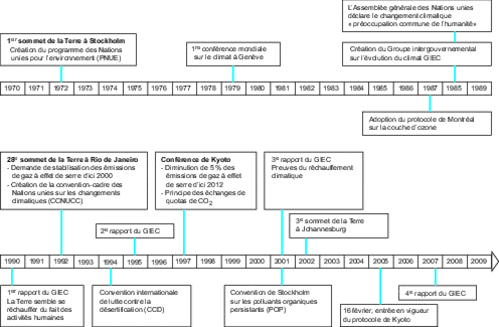
The media has reported on the various meetings and findings of the Intergovernmental Panel on Climate Change (IPCC) regarding global warming and climate change caused by significant amounts of greenhouse gases emitted into the atmosphere. It is worth noting that the IPCC was awarded the Nobel Peace Prize in 2007 for its work and efforts. The evolution of the ozone hole
This combination of factors prompted the international community to take action. Politicians made commitments at global conferences, and measures followed at the national level to control and reduce pollutant emissions. One notable example is the Geneva Protocol of November 1991, signed by 21 countries. Building on this, the fight against rising greenhouse gas emissions was formalized through the Rio Convention in June 1992. Although challenges remain—as evidenced by the events at the 1997 conferences in New York and Tokyo, the 2000 conference in The Hague, or, more recently, the IPCC meetings, European directives transposed into French law in the form of ministerial decrees, such as that of February 2, 1998, amended by the decree of May 29, 2000, are currently in effect (see the Regulations section
This article begins by presenting a broad overview of the various pollutants emitted naturally or as a result of human activities, along with their impacts on both human health and the environment. These findings naturally lead to a consideration of emission treatment options aimed at reducing pollution levels in accordance with international commitments. Next, a classification of air purification processes...

Exclusive to subscribers. 97% yet to be discovered!
Already subscribed? Log in!
CAN BE ALSO FOUND IN:
Introduction to air treatments
 Air quality and pollutants to be addressed
Macroeconomic data
Exclusive to subscribers. 97% yet to be discovered!
Already subscribed? Log in!
Article included in this offer
"Environment"
(
527 articles
)
Updated and enriched with articles validated by our scientific committees
A set of exclusive tools to complement the resources
