

Overview
ABSTRACT
The need for gas-barrier materials are increasing in the packaging sector. Constraints of recycling, marketing, weight and cost have led to the development of innovative solutions to replace glass or metal packaging. The solutions are multiple and must, most importantly, meet specifications which are as diverse as the possible applications in order to minimize the "barrier cost". Amongst polymer-based barrier packaging, the multilayer solution remains the most widely used.
Read this article from a comprehensive knowledge base, updated and supplemented with articles reviewed by scientific committees.
Read the articleAUTHOR
-
Stéphane CROS : Research Engineer at the French National Institute for Solar Energy - Systems Components Laboratory, CEA/ DRT/ LITEN
INTRODUCTION
The need for gas-barrier materials, essentially water and oxygen, is growing in the packaging sector and for container protection in general (see figure at end of introduction). This process is linked to growing demand in fields as diverse as food, medical packaging and optoelectronics.
Recycling, marketing (transparency), weight and cost constraints are leading to the development of innovative solutions to replace glass or metal packaging with very high barrier capacities.
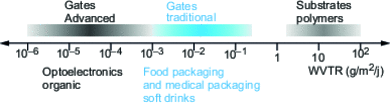
While a wide range of technologies are used, from multilayer to plasma deposition, from scavenger to nanofiller insertion, from polymer blending to polymer deposition, they must above all meet specifications that are as diverse as the possible applications (see figure below and table at end of introduction), in order to minimize the "barrier cost".
In terms of polymer-based barrier packaging, the multilayer solution is still the most widely used. However, the requirements of fields such as PET (polyethylene terephthalate) bottling have led to the commercial development of techniques such as surface deposition, which is widely used today (see last table).
Other technologies, such as scavenger insertion, nanocomposites and polymer blends, are also on an upward ramp.
Although this document deals with barrier packaging, it will not dwell on barrier resins and multilayer structures, which have already been described in other articles in Techniques de l'Ingénieur, but will provide additional information and an overview of barrier technologies.

Exclusive to subscribers. 97% yet to be discovered!
Already subscribed? Log in!
Barrier properties of polymers used in packaging
 Material permeability
References
Exclusive to subscribers. 97% yet to be discovered!
Already subscribed? Log in!
Article included in this offer
"Plastics and composites"
(
355 articles
)
Updated and enriched with articles validated by our scientific committees
A set of exclusive tools to complement the resources
