

3. Gibbs phase rule and lever arm rule
In this section, we group together two rules of unequal importance. Gibbs' phase rule is universal in scope, and enables us to count the coexisting phases in a system of any multiplicity, in relation to the number of degrees of freedom in that system. The second rule, known as the lever arm or inverse segment rule, applies only to binary systems, and is a geometric image of the mass balance of the two phases in a two-phase domain.
3.1 Gibbs phase rule

Exclusive to subscribers. 97% yet to be discovered!
Already subscribed? Log in!
Gibbs phase rule and lever arm rule

 Phases in metal alloys
Diagram classification
In this folder, the diagrams are arranged in alphabetical order of the symbol of the element concerned, which comes first in alphabetical order among the elements making up the alloy; then, for a given element, in alphabetical order of the symbol of the second element.
Example
we find Fe-C to C-Fe.
However, in the diagrams, the base element of...
Binary alloys containing Ag

Binary alloys containing Al
Binary alloys containing As
As-Cu (arsenic-copper – figure )
This diagram has recently been completely revised. The relationships between phases and their compositions are now well known; there are apparently no other intermediate phases richer in arsenic than those shown in the diagram.
-
Phase structures
(Cu) : c. f. c.
Cu8As :...
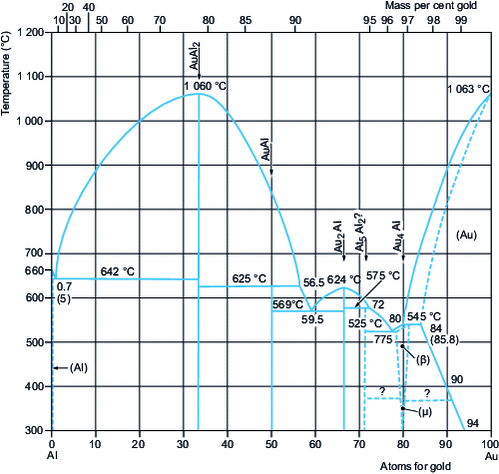
Au-containing binary alloys

Binary alloys containing either B, Be or Bi

Binary alloys containing C

Binary alloys containing either Ca, Cd or Ce

Binary alloys containing Co

Binary alloys containing Cr

Binary alloys containing Cu

Binary alloys containing Fe

Binary alloys containing Li, Mg or Mn

Binary alloys containing either Mo, or N, or Nb, or Ni, or O

Binary alloys containing either Pb, Sb, Sn or Ti

Exclusive to subscribers. 97% yet to be discovered!
Already subscribed? Log in!
Article included in this offer
"Studies and properties of metals"
(
199 articles
)
Updated and enriched with articles validated by our scientific committees
A set of exclusive tools to complement the resources
