

Overview
Read this article from a comprehensive knowledge base, updated and supplemented with articles reviewed by scientific committees.
Read the articleAUTHOR
-
Georges HENRIOT: Arts et Métiers engineer - Former Technical General Manager of Engrenages et Réducteurs
INTRODUCTION
A gear is a device that connects two shafts, transmitting rotational motion from one of the shafts (the driving or motor shaft) to the other (the driven shaft), with a constant ratio of angular speeds.
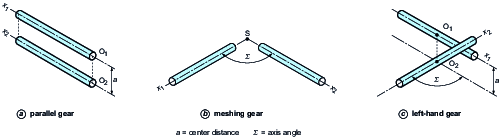
Depending on the relative position of the two shafts to each other, we have three main gear classes:
Parallel gears: the two axes are parallel (figure 1 a).
Concurrent gearing: the two axes intersect along their extensions (figure 1 b).
Left-hand gear: the two axes occupy any relative position; they are neither parallel nor intersecting (figure 1 c).
This section on gears is made up of several articles.
The first two articles deal with parallel gears, the first being devoted to geometrical studies, the second to tooth corrections. .
In the following article, we'll be taking a closer look at left-hand and right-hand gears. and, in a fourth section, loads on gears and strength calculations. .
The final section deals with manufacturing methods and planetary gear trains. .

Exclusive to subscribers. 97% yet to be discovered!
Already subscribed? Log in!
Parallel gears
 General definitions
Article included in this offer
"Mechanical functions and components"
(
212 articles
)
Updated and enriched with articles validated by our scientific committees
A set of exclusive tools to complement the resources
Exclusive to subscribers. 97% yet to be discovered!
Already subscribed? Log in!
