Overview
Read this article from a comprehensive knowledge base, updated and supplemented with articles reviewed by scientific committees.
Read the articleAUTHOR
-
Stéphane GORSSE : Doctor - Senior lecturer at ENSCBP-IPB - CNRS, ICMCB, UPR 9048, F-33600 Pessac, France - University of Bordeaux, ICMCB, UPR 9048, F-33600 Pessac, France
INTRODUCTION
Thermoelectric generators are static, autarkic devices that convert thermal energy into electrical energy . They are made up of several pairs of n- and p-type semiconductors (thermoelements), connected electrically in series and thermally in parallel. Heat applied to one side of the thermoelectric generator forces electrons (in the n-type material) and holes (p-type) to migrate to the opposite (cold) side, generating an electric voltage due to the Seebeck effect and an electric current driven by the heat flow.
Because of its reliability, compactness and robustness, as well as the absence of moving parts and vibration, thermoelectric conversion has established itself as a vital technology for space applications, providing an electrical source for the interplanetary probes Pioneer, Voyager, Ulysses, Galileo and Cassini, as well as the Apollo lunar and Viking Mars missions, for a total of several million hours of operation in space. These applications use the nuclear decay of radioactive isotopes as a heat source, and a "radioisotope" generator supplies electrical power by converting the heat emitted by the radioactive core.
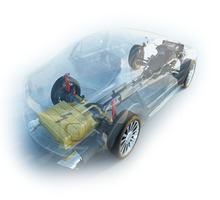
On Earth, the sources of heat produced by industrial activity and transport are abundant and free (because they are lost). The automobile is an emblematic example, since three-quarters of the energy produced by the combustion of hydrocarbons is rejected by the exhaust or dissipated by the cooling circuit. Lowering CO
2
emission standards for automobiles, and therefore fuel consumption, is a major environmental issue, and binding measures instituted by the European Commission plan to reduce these emissions to 130 g/km by 2012 and 95 g/km by 2020. At the same time, the rapid development of automotive equipment, such as driving assistance, navigation and active safety systems, requires ever more electrical energy, which in turn increases consumption. The idea of integrating a heat loss recovery system based on a thermoelectric converter into automobiles offers the possibility of harnessing tens of kilowatts of waste heat to generate electricity without any additional load on the engine. The use of a thermoelectric device could achieve fuel savings of up to 10% by powering all the vehicle's accessories, saving the alternator and the energy it consumes, and using this surplus electrical production for propulsion in the case of hybrid cars. The sun is another abundant and free source of energy that could be harnessed competitively using thermoelectric conversion

Exclusive to subscribers. 97% yet to be discovered!
Already subscribed? Log in!
Nanostructured and architected thermoelectric materials
 Thermoelectric material performance and conversion efficiency of a thermoelectric generator
Article included in this offer
"Functional materials - Bio-based materials"
(
201 articles
)
Updated and enriched with articles validated by our scientific committees
A set of exclusive tools to complement the resources
Bibliography
Exclusive to subscribers. 97% yet to be discovered!
Already subscribed? Log in!