Description of the "medium temperature" process
Phthalic anhydride — Medium-temperature" process

Add to my library

J6155 V1 Article

Description of the "medium temperature" process


Phthalic anhydride — Medium-temperature" process

Author : Nicolas LEPEU

Publication date: March 10, 2001 | Lire en français

Add to my library Add to my library

Logo Techniques de l'Ingenieur You do not have access to this resource.
Request your free trial access! Free trial

Already subscribed?

1. Description of the "medium temperature" process

1.1 Principle

The controlled oxidation of orthoxylene or naphthalene with air between 350 and 430 ˚C (hot spot), in a fixed-bed vertical tubular reactor, leads to the following chemical reaction: .
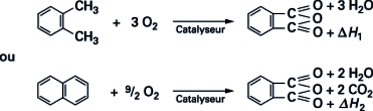
The enthalpies of reaction (taking into account by-products and combustion) are respectively :

• ΔH ...

You do not have access to this resource.
Logo Techniques de l'Ingenieur

Exclusive to subscribers. 97% yet to be discovered!

You do not have access to this resource. Click here to request your free trial access!

Already subscribed?


Ongoing reading
Description of the "medium temperature" process

Article included in this offer

"Unit operations. Chemical reaction engineering"

( 343 articles )

Complete knowledge base

Updated and enriched with articles validated by our scientific committees

Services

A set of exclusive tools to complement the resources

View offer details

Dans les ressources documentaires

Anhydride acétique

Mise à jour du texte de Rhône-Poulenc paru en 1988 dans ce traité L’anhydride acétique (figure  1 ), sy...

Chlorométhanes

Le terme chlorométhanes caractérise la famille regroupant les quatre dérivés chlorés du méthane. On dis...

Peroxyde d’hydrogène

Le peroxyde d’hydrogène, plus connu sous le nom d’ eau oxygénée , est un liquide incolore utilisé princip...

Trichloroéthylène

Le trichloroéthylène a été fabriqué pour la première fois par E. Fisher en 1864. Largement utilisé en tan...

Tous les livres blancs
Article COV : une membrane pour les éliminer ?
26 May 2026
COV : une membrane pour les éliminer ?

L’air intérieur est particulièrement pollué, notamment à cause des composés organiques volatils (COV), des substances, dont certaines toxiques, issues des objet...

Toutes les actualités
Contact us