Overview
Read this article from a comprehensive knowledge base, updated and supplemented with articles reviewed by scientific committees.
Read the articleAUTHORS
-
Marc FIVEL : Associate Professor of Mechanics, École normale supérieure de Cachan - Doctorate in mechanics - CNRS Research Fellow - Grenoble National Polytechnic Institute
-
Samuel FOREST : Civil engineer from the École des Mines de Paris - Doctor of Materials Science and Engineering - CNRS Research Fellow - École nationale supérieure des mines de Paris
INTRODUCTION
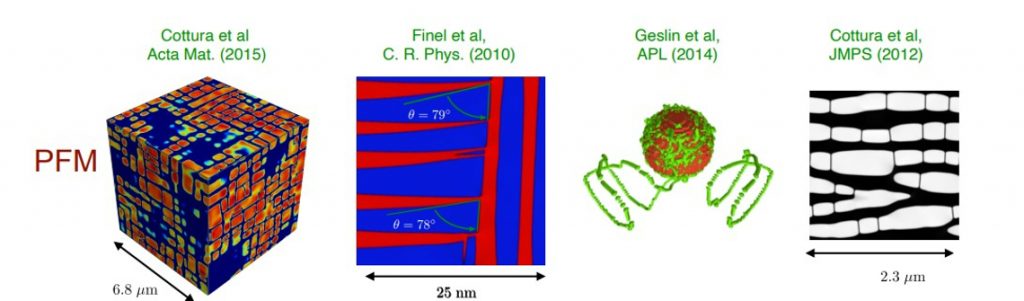
In the article , elastoviscoplastic behavior laws have been established for single crystals on the basis of changes in scale, from atomistics through dislocation dynamics to continuum mechanics. They are used in this second article to predict the mechanical response of polycrystals and the scaling effects observed in many metal alloys.
First, methods for simulating polycrystalline aggregates and the fundamental principles of homogenization methods are presented in detail. Applications include modeling the distortion of load-bearing surfaces, studying the behavior of polycrystals under multiaxial loading and the influence of grain boundaries on intragranular deformation heterogeneities.
Finally, we show the limits of the classical continuous approach when it comes to reproducing scale effects commonly observed in physical metallurgy. The dynamics of dislocations can account for many of these effects, notably the Hall-Petch effect. However, it is possible to describe some of these effects using a generalized continuous medium approach, for example by incorporating the notion of crystal lattice curvature and its effect on strain hardening.
Most of the quantities, notations and symbols used in this article were introduced and defined in the article

Exclusive to subscribers. 97% yet to be discovered!
Already subscribed? Log in!
Crystalline plasticity and scale transition: the case of polycrystals
 Polycrystal behavior
Article included in this offer
"Studies and properties of metals"
(
172 articles
)
Updated and enriched with articles validated by our scientific committees
A set of exclusive tools to complement the resources