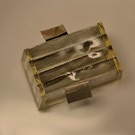
Alumina prosthesis components
Ceramic biomaterials for orthopaedic prostheses

Add to my library

MED7100 V1 Article

Alumina prosthesis components


Ceramic biomaterials for orthopaedic prostheses

Authors : Laurent GREMILLARD, Jérôme CHEVALIER

Publication date: January 10, 2016 | Lire en français

Add to my library Add to my library

Logo Techniques de l'Ingenieur You do not have access to this resource.
Request your free trial access! Free trial

Already subscribed?

3. Alumina prosthesis components

Introduced in 1965, alumina has the triple advantage of being readily available, having good mechanical properties and being biocompatible.

The first developments made on this basis consist in strengthening the material by optimizing it (optimization of purity, density, grain size... to eliminate defects).

3.1 Introduction to alumina

Alumina is one of the most widely used technical ceramics, thanks to a combination of properties that include hardness (up to 20 GPa), stiffness (Young's modulus up to 400 GPa), breaking strength (breaking stress up to 650 MPa), chemical inertia, refractoriness and lightness (density around 4).

It can exist in various crystallographic phases, but the only phase stable at the temperatures...

You do not have access to this resource.
Logo Techniques de l'Ingenieur

Exclusive to subscribers. 97% yet to be discovered!

You do not have access to this resource. Click here to request your free trial access!

Already subscribed?


Article included in this offer

"Glasses and ceramics"

( 66 articles )

Complete knowledge base

Updated and enriched with articles validated by our scientific committees

Services

A set of exclusive tools to complement the resources

View offer details

Dans les ressources documentaires

Biomécanique cardiovasculaire et dispositifs médicaux implantables

Les maladies cardiovasculaires représentent l'une des premières causes de mortalité. Cet article s'intére...

Apatites biomimétiques - Des biominéraux aux analogues de synthèse pour le biomédical

Les apatites constituent une vaste famille de composés inorganiques, incluant les apatites phosphocalciqu...

Zircone - Céramique fonctionnelle

La zircone, ou oxyde de zirconium (dioxyde), a suscité un vif intérêt dès le début de son identification ...

Biomatériaux à base de phosphates de calcium

Les biomatériaux à base de phosphates de calcium (CaP) se sont considérablement développés au cours des d...

Tous les livres blancs
Article Bientôt des organes bio-artificiels !
23 July 2014
Bientôt des organes bio-artificiels !

Créés par l\'homme ou d\'origines animale, les biomatériaux composant les bioprothèses sont biocompatibles. Non rejetés par le système immunitaire, leur princip...

Toutes les actualités
Contact us