Overview
Read this article from a comprehensive knowledge base, updated and supplemented with articles reviewed by scientific committees.
Read the articleAUTHOR
-
Marie-Florence GRENIER-LOUSTALOT : Director of Research at the Centre national de la recherche scientifique - URA 1494 - Polymer Physical Chemistry Laboratory
INTRODUCTION
Nuclear magnetic resonance (NMR) spectroscopy is now one of the most powerful tools for elucidating chemical structures. In the case of polymers in solution, it provides easy access to essential structural information (microstructure, tacticity, motif distribution). However, the use of liquid-phase NMR seems to be limited to liquid or soluble polymers. In fact, a large number of insoluble polymers are "swellable" in suitable solvents and can be studied by this technique. Only infusible, "non-swellable" polymers require the use of CP-MAS (Croised Polarisation-Magic Angle Solid).
.
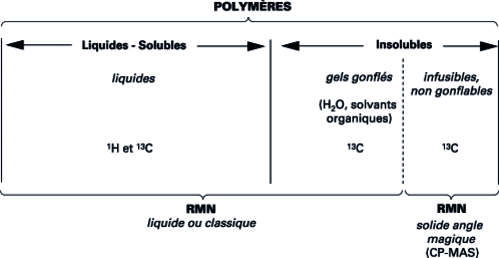
We have summarized below the contribution of NMR to the study of polymers.
This technique enables :
good knowledge of the microstructure (skeletal tacticity, chain ends, structural anomalies, stereoregularities, etc.);
a good understanding of the reaction mechanisms (polycondensation, polymerization, degradation, etc.) that can govern polymerization, and enable reliable relationships to be established between microstructures, physical properties and mechanical properties, given the high detection sensitivity and spectral resolution of high-field spectrometers.
In recent years, high-resolution carbon-13 NMR in solids (magic angle rotation and CP/MAS cross-polarization) has been developed for polymers. While high-resolution carbon-13 NMR in liquids is a prodigious source of information, since each carbon of a molecule in solution can be matched to a peak in the spectrum, obtaining the same result for a compound in solid phase is not as immediate. However, this technique has proved useful for :
determination of insoluble three-dimensional polymer structures;
-
the study of solid-phase organization in polymers. In particular, it is possible to study :
conformations and configurations of the chain's carbon skeleton,
crystal structure showing polymorphism, amorphous and crystalline zones and intermediate zones in semi-crystalline polymers,
compatibility of polymer blends.
After outlining some of the general principles involved...

Exclusive to subscribers. 97% yet to be discovered!
Already subscribed? Log in!
NMR characterization of polymers
 General information on obtaining a spectrum
Article included in this offer
"Plastics and composites"
(
356 articles
)
Updated and enriched with articles validated by our scientific committees
A set of exclusive tools to complement the resources
References
Exclusive to subscribers. 97% yet to be discovered!
Already subscribed? Log in!