

Overview
ABSTRACT
Oceans contain many sources of renewable energy which remain relatively untapped. This article presents the large number of existing technologies for wave energy conversion and the related testing systems. The order of magnitude of the resource is presented at the global level and for the French Atlantic coast. The various conversion principles, new trends as well as certain elements concerning yield and thermo-chemical analysis, are presented. Finally, the experimental facilities required for the development of a wave energy converter are described.
Read this article from a comprehensive knowledge base, updated and supplemented with articles reviewed by scientific committees.
Read the articleAUTHORS
-
Aurélien BABARIT: Research engineer at the LHEEA laboratory (CNRS UMR6598), École centrale de Nantes
-
Hakim MOUSLIM: Research engineer at the LHEEA laboratory (CNRS UMR6598), École centrale de Nantes
INTRODUCTION
The world's oceans are home to many sources of renewable energy, virtually untapped today. These include :
tidal energy, well known in France with the example of the Rance tidal power plant;
current energy with tidal turbines;
deep offshore wind energy, where innovative floating foundations need to be designed;
Thermal energy from the seas, in tropical areas, where the difference in temperature between warm surface waters and the cold waters at great depths (1,000 to 2,000 m) is exploited;
energy from salinity gradients, at river mouths where the difference in salinity between freshwater and seawater is exploited by osmotic pressure;
and finally, wave energy, the waves that animate the surface of the oceans. It's the recovery of this last form of marine energy that is the subject of this article.
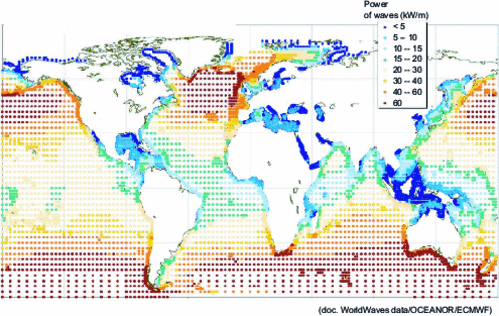
On a global scale, the technically exploitable potential of wave energy is estimated at around 30,000 TWh/year (1 TWh = 1 billion kWh). If we compare this figure with global energy consumption in 2008, which was in the region of 100,000 TWh, we realize that wave energy is not the only definitive solution to the energy crisis, but that it can make a significant contribution.

Exclusive to subscribers. 97% yet to be discovered!
Already subscribed? Log in!
KEYWORDS
review | medium and full scale experimental facilities | | |
Wave energy recovery
 Resource
Article included in this offer
"Energy resources and storage"
(
208 articles
)
Updated and enriched with articles validated by our scientific committees
A set of exclusive tools to complement the resources
Bibliography
Exclusive to subscribers. 97% yet to be discovered!
Already subscribed? Log in!
