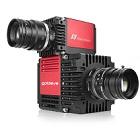
Ultra-fast cinematography — Electronic cameras

Add to my library

R6732 V1 Article

Ultra-fast cinematography — Electronic cameras

Author : Noël FLEUROT

Publication date: June 10, 2006 | Lire en français

Add to my library Add to my library

Logo Techniques de l'Ingenieur You do not have access to this resource.
Request your free trial access! Free trial

Already subscribed?

Overview

Read this article from a comprehensive knowledge base, updated and supplemented with articles reviewed by scientific committees.

Read the article

AUTHOR

  • Noël FLEUROT : Doctorate in Physical Sciences (Electrical Engineering) French Atomic Energy Commission (CEA-DAM) Bruyères le Châtel

 INTRODUCTION

In order to break down movements of objects that are too fast to be captured by the eye, optical cinematography has, since its inception [1] , made use of the three dimensions contained in each image (two spatial dimensions and one intensity dimension). The "time base," which provides a regular succession of images, makes it possible to locate the evolution of an object at different moments and to measure its speed and even its acceleration; if the object is deformed, the speed of deformation can also be measured. Transposed to an industrial or laboratory environment, this technique also allows for the measurement of timing and synchronization of events. The dimension of light intensity, when linked to spectral information, can also provide access to the temperature evolution of the objects observed.

The 1950s made analysis times ranging from milliseconds to microseconds accessible for the most sophisticated equipment of the time. Many industrial applications correspond to this time range.

The 1960s saw these optical cameras gradually reach their ultimate resolution limits. They were then replaced by electronic cameras, which offer higher temporal resolution and use double conversion (photon-to-electron and electron-to-photon) in an electronic tube known as an "image converter." The increase in speed achieved through electronic manipulation of the intermediate image provides access to the time domain between microseconds (10 -6 s) and picoseconds (10 -12 s) for standard cameras, thus opening up a particularly wide range of applications in laboratories.

The most powerful cameras currently achieve a temporal resolution of around a few hundred femtoseconds (1 femtosecond = 10- -15 s) in "slit scanning" mode, which is still two to three orders of magnitude above the shortest light pulses currently produced.

You do not have access to this resource.
Logo Techniques de l'Ingenieur

Exclusive to subscribers. 97% yet to be discovered!

You do not have access to this resource. Click here to request your free trial access!

Already subscribed?


Ongoing reading
Ultra-fast cinematography — Electronic cameras

Article included in this offer

"Mechanical and dimensional measurements"

( 124 articles )

Complete knowledge base

Updated and enriched with articles validated by our scientific committees

Services

A set of exclusive tools to complement the resources

View offer details

Contenus associés

Sur le même sujet

Veille personnalisée : Inscrivez-vous !

Dans les ressources documentaires

Enregistrement rapide des images - Introduction

Les réactions humaines à un événement subit ne sont pas immédiates. Il en est ainsi pour un observateur e...

Mesures dimensionnelles par vision

La vision industrielle est une technologie utile et souvent nécessaire dont les performances répondent au...

Thermographie - Technologies et applications

Les technologies des caméras thermiques sont basées sur des matrices de détecteurs quantiques ou thermiqu...

WhitePaper
4 December 2018
Caméra thermique : FLIRGFx320

Caméra infrarouge pour la détection des gaz à sécurité intrinsèque. Description produit de deux pages

Tous les livres blancs
Article Invitation Stemmer Imaging
24 February 2015
Invitation Stemmer Imaging

[Publireportage] Infrarouge, caméra embarquée et technologie 3D - Journées Techniques le 17 mars à Strasbourg et le 19 mars à Lyon - Stemmer Imaging

Toutes les actualités
Contact us