Overview
Read this article from a comprehensive knowledge base, updated and supplemented with articles reviewed by scientific committees.
Read the articleAUTHORS
-
Mustapha BESBES : Professor Emeritus at the National Engineering School of Tunis - University of Tunis El Manar
-
Jamel CHAHED : Professor at the National Engineering School of Tunis - University of Tunis El Manar
-
Hedi SHAYEB : Professor at the National Engineering School of Tunis - University of Tunis El Manar
-
Abdelkader HAMDANE : Honorary Director General of Génie Rural - Scientific advisor to the National Agronomic Institute of Tunisia - Carthage University
INTRODUCTION
In 2011, Tunisia had a population of 10.7 million. The country's average rainfall, estimated at 36 km 3 /year, is, due to the aridity of the climate, 88% taken up by evapotranspiration: 28% in forests and rangelands, 17% in wetlands, 10% in deserts and 33% on cultivated land. The remaining 12% is fed by run-off: wadis and groundwater from which irrigation, practised on around 400,000 hectares, accounts for 80% of withdrawals, with the remainder used to supply communities, industry, tourism and safeguard aquatic ecosystems. The per capita quota of renewable water resources is currently 400 m 3 /capita/year, placing Tunisia among the world's least endowed countries in terms of freshwater resources.
The aim of water planning is to fully develop water resources in order to enhance the country's development. Tunisia's water program is based on the construction of a major infrastructure of large dams, small dams and hill lakes, as well as numerous wells and deep-water boreholes, which have mobilized 81% of identified water resources. These structures are linked by a complex network of pipes and canals, enabling the transfer of water resources from regions rich in water resources - the North and West - to those lacking them - the coastal areas of the East, where populations and water needs are traditionally concentrated.
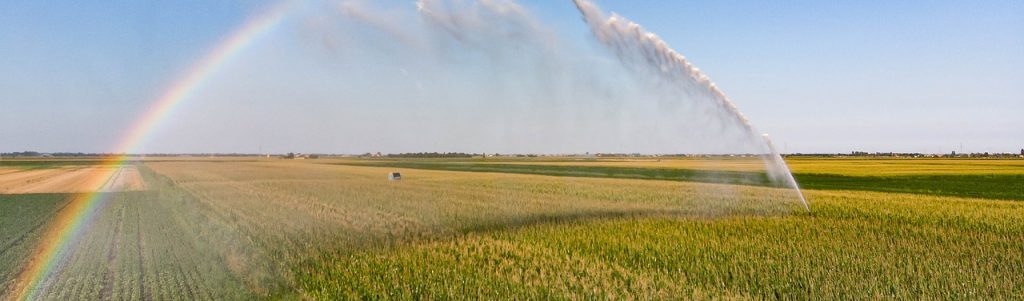
With irrigated agriculture using most of the available water, and demand for drinking water set to grow at least as fast as the population, Tunisia will in the near future have to solve the most paradoxical hydraulic equation in its history: making irrigated agriculture produce far more than it does today, while using less water. The country's food security will therefore depend on its ability to save water in all its uses, and in particular to master irrigation. Thanks to a system of financial incentives and subsidies for smallholders, the rate of water-saving systems has already reached 80% of irrigated areas, including 30% equipped with localized irrigation. In ten years, this strategy has stabilized Tunisia's demand for irrigation water, despite the expansion of irrigated areas.
Today, water withdrawals are approaching the order of magnitude of resources, and the marginal costs of water supply are rising and beginning to exceed the economic benefits offered by the least productive uses. This translates into increased interdependence between the various sectors of use, and the risk of potential conflicts looming on the horizon: water is becoming a limiting factor in socio-economic development. Related to the economic aspect of water are questions concerning the development and optimal use of alternative resources: reuse of treated wastewater,...

Exclusive to subscribers. 97% yet to be discovered!
Already subscribed? Log in!
Water in Tunisia
 Water resources
Article included in this offer
"Water technologies"
(
117 articles
)
Updated and enriched with articles validated by our scientific committees
A set of exclusive tools to complement the resources
Bibliography
Exclusive to subscribers. 97% yet to be discovered!
Already subscribed? Log in!