
Plastics and composites
347 articles
Make the most of these materials with their high development and application potential

Techniques de l'Ingénieur provides access to the leading technical and scientific database. It enables users to quickly find reliable, comprehensive, and always up-to-date information. Validated by leading experts, it supports engineers and scientists from industry, design offices, and R&D centers in carrying out their projects.
Each type of article meets a specific need (authoritative article, how-to sheet, video article, experience feedback article...) and is enriched with medias (quizzes, tables, visuals, illustrations, equations), bibliographic or economic data, and links to reference organizations or information on standards and patents.

Each sector of activity and each profession has its own specific characteristics. Browse our areas of expertise, from materials to biotechnologies, mechanics and ICT, and discover offers adapted to your projects.

To stay permanently up to date!
Regular updates to our resources ensure always up-to-date information.
Straw bale construction is a bio-based building system whose durability largely depends on the control of interfaces with adjacent building components. This article examines critical junctions (base of walls, wall-to-roof connections, openings, horizontal surfaces and service penetrations) from hygrothermal, structural and regulatory perspectives. It proposes an engineering methodology integrating risk prioritization, climate adaptation and coordination of applicable standards to ensure long-term robustness and reliability.
The atomic absorption Sspectrometry, elemental quantification technique, is based on analysing the wavelengths generated by a light source and not absorbed by the element; the degree of absorption is proportional to the concentration. The detection limits are in the order of mg/L or µg/L depending on the atomisation method used (flame or graphite furnace). It also allows the analysis of mercury by cold vapours, as well as hydrides of several elements (As, Sn, Se, etc.). After reviewing the fundamental theoretical principles, this article describes the equipment in detail, highlights issues related to quantification and interference, and provides numerous examples of applications.
The ISO/IEC 17025 standard ‘General requirements for the competence of testing and calibration laboratories’ requires measurement methods to be validated when they are not standardised or when they are used outside the scope of application provided for by the standard, and to associate an uncertainty with the measurement value. Chemical analysis laboratories generally know how to validate their measurement methods, but they sometimes encounter difficulties in assessing measurement uncertainty. This document outlines the various ways, covered by the ‘Guide to the expression of uncertainty in measurement’ (GUM), of assessing it, using data from within or outside the laboratory.
Dissolution, slag infiltration into the porosity of refractories, and erosion of the transformed surface are all mechanisms involved in the degradation of refractories by slag in steelmaking. The examples presented—based on industrial practices—illustrate the corrosion of different families of refractories during the stages of steel production.
A wide variety of refractory materials are used in a steel mill, with approximately 500 commercial grades for consumable refractories alone. This is due to an ongoing effort to optimize their performance and costs. From the upstream to the downstream sections of the plant, several major families of refractories are used, all of which are absolutely essential and whose development has at times been a key factor in the emergence of steelmaking processes—for example, magnesia-carbon bricks for the oxygen-blown converter process in the 1970s. During steel production, slags and temperatures vary significantly across different furnaces and equipment; this is the primary reason why different types of refractories must be used.
This article deals with the production of stainless steel. Stainless steels are produced in various grades, forms and finishes. The main process routes include: stainless steel melting: raw materials are melted in an electric arc furnace (EAF); refining process: refining takes place in a refining vessel using either a process gas (Argon Oxygen Decarburization (AOD) converter) or vacuum (Vacuum Oxygen Decarburization (VOD) vessel); ladle metallurgy: before casting, various metallurgical operations can be performed; casting: ingot casting (old technique) or continuous casting (slab caster or bloom caster); hot coil rolling or hot bar rolling; cold rolling and finishing of flat products or cold drawing and finishing of long products.
This article compiles the numerical values of enthalpy variations, between 25°C and various temperatures, for pure substances, elements, and compounds. It also includes the temperatures and enthalpy variations associated with phase transformations of some of these pure substances. Enthalpy of formation values for compounds at different temperatures are also reported. Secondly, a technique for evaluating the enthalpy of dissolution of elements in pure or low-alloyed liquid iron is presented. Finally, the document also presents data relative to various industrial materials such as steelmaking slags, fuels, coke, and pig iron.
The standard electrode potential is used to represent the thermodynamic state of a system and its value is measured versus a stable and well-known electrode potential (reference electrode). It allows predicting the reactivity of the oxydo-reducing species in solution. The oxydo-reducing systems (so-called redox), in aqueous solution, are conventionallyclassified according to their standard potential, expressed in volt, compared with the H+/H2 system. That list, established from several works, is very useful in surface treatments in aqueous media.
Artificial intelligence is reshaping industrial processes—predictive maintenance, quality control, energy optimisation—yet many projects fail due to poor organisational readiness. This article introduces an AI maturity audit—a simple method to assess a company’s ability to adopt such technologies. Built around six key levers—strategy, organization, people, offer, technology and environment—the audit reveals hidden barriers and supports a structured, sustainable approach before launching any AI project.
If we are looking for a food that has its roots in Antiquity, cereals and more specifically ancient wheats are a model of culture that has fed billions of people in the past and still does today. This process sheet immerses us in a vast field that continues to improve to meet consumer expectations in terms of pasta and noodles that are already flooding the planet, with competitive prices and practicality of use.
All your resources benefits
Content written and validated by recognized specialists to ensure reliability and expertise
Our experts committeeFrom state of the art to innovation, the Techniques de l’Ingénieur documentary resource is the reference tool for engineers and scientists in industry, engineering consultancies, and R&D.
This documentary collection, composed of more than 10,000 reference articles and practical fact sheets, is also used as a training support for science students in technological programs and engineering schools.
The Techniques de l’Ingénieur database is the largest technical and scientific documentation resource, essential for quickly finding reliable and actionable information.
This resource is constantly updated, and all of its content follows a comprehensive quality process, including validation by expert committees.

Each new article follows a process of excellence:
From topic selection to final proofreading, including the intermediate stages of defining perspectives and outlines, each step follows a quality process that guarantees the reliability of the information delivered.
You will find in the database more than 10,000 reference articles, practical fact sheets, and interactive articles enriched with quizzes and practical modules. This database is continuously updated.
In addition to this documentary database, each year you will find in the News Magazine more than 500 in-depth news articles to support your technical and technological monitoring.
The Techniques de l’Ingénieur website offers several ways to access information. Through standard search or via the conversational chatbot, you can also browse the tree structures or explore the interactive map .
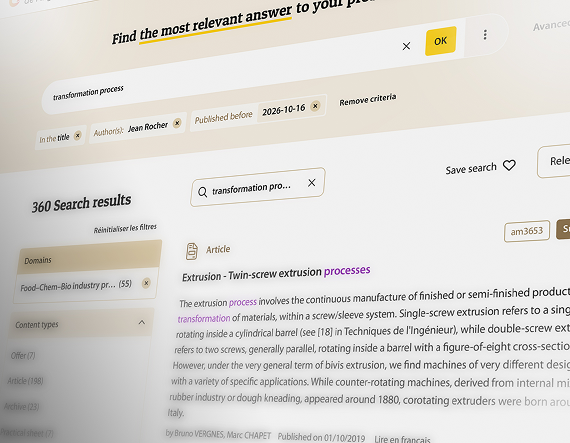
In the search engine, you can perform a search by phrase or keywords. You can refine your search using:
Advanced search criteria:
Or filters:
To meet all needs, several article formats are available:
Finally, to enhance understanding, you will also find:
Each of the 10,000 reference articles is illustrated with elements such as:
Articles are also supplemented with economic or bibliographic data:
We also offer more operational formats. Practical fact sheets are a variant of articles designed to meet field needs and are structured as successive steps, like a step-by-step implementation guide. Practical modules are built around a concrete issue. Structured step by step, they include educational fact sheets, ready-to-use solutions, downloadable practical tools, and quizzes to reinforce learning.
Access our most in-demand offers and leverage their benefits to innovate!

Plastics and composites
347 articles
Design and production
147 articles
Eco-design and sustainable innovation
136 articles

Vehicules and mobility
91 articles
Batteries
29 articles

Cosmetics: from design to product
57 articles