
Plastics and composites
326 articles
Make the most of these materials with their high development and application potential

Techniques de l'Ingénieur provides access to the leading technical and scientific database. It enables users to quickly find reliable, comprehensive, and always up-to-date information. Validated by leading experts, it supports engineers and scientists from industry, design offices, and R&D centers in carrying out their projects.
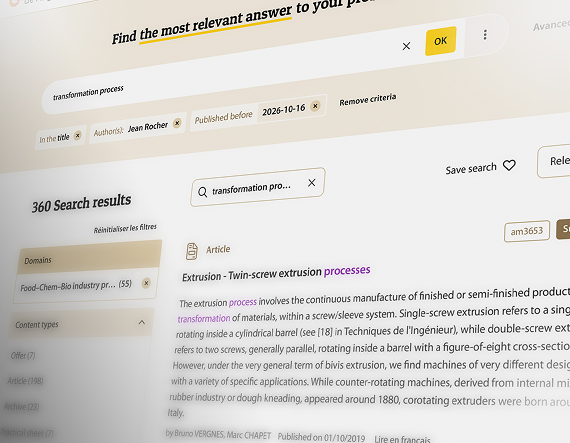
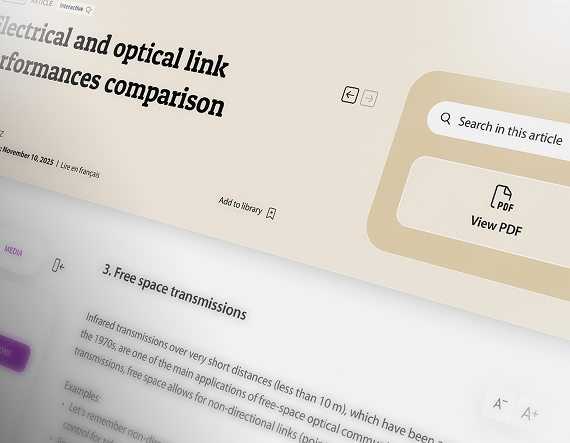
Each type of article meets a specific need (authoritative article, how-to sheet, video article, experience feedback article...) and is enriched with medias (quizzes, tables, visuals, illustrations, equations), bibliographic or economic data, and links to reference organizations or information on standards and patents.
Each sector of activity and each profession has its own specific characteristics. Browse our areas of expertise, from materials to biotechnologies, mechanics and ICT, and discover offers adapted to your projects.

To stay permanently up to date!
Regular updates to our resources ensure always up-to-date information.
The risk of explosive atmospheres (ATEX) is frequent in laboratories due to the use of inflammable products(gases or liquids). A regulation has been drafted in order to improve the health and safety of workers exposed to the ATEX risk. This article is dedicated to the implementation of this regulation within laboratories. The regulation, its principles and main requirements as well as the definition of ATEX zones are firstly listed. The implementation of this regulation in laboratories is then presented on the basis of general information and illustrated with a few cases of common situations.
In 2008 Satoshi Nakamoto defined a new model of currencies. The issuance and management of such a currency take place on a peer-to-peer network without central control. Bitcoin is the first cryptographic currency created on this model. It exists since January 2009.As the 7000 other crypto-currencies of the same type created in its wake, it works through what is called a blockchain. This shared file and collectively controlled file by a peer-to-peer network can be used for many other purposes. Many applications are developed and implemented gradually, especially in the world of banking and finance.
Meteorological measurements aim to quantify the different quantities that characterize the physical and thermodynamic state of the atmosphere, such as wind, temperature, humidity, solar radiation. Meteorological measurements can have various purposes, which condition the exposure of the sensors, a major factor for their representativeness.This article focuses on detailing each of these quantities (definitions, types of measurements carried out, influencing factors and exposure rules), mainly for in-situ measurements.
HF-guiding structures connect the components of a system or supply the power. Various techniques have been developed to design guiding structures and obtain the best performances. However, the technical implementation depends on their application and frequency. In this article, various processes to implement components in planar, multilayer technologies and additive manufacturing are presented. Then, the concept of a multi-port device scattering matrix that is used for computer-aided design is addressed. Furthermore, performances such as attenuation and power-handling capacity of several guiding structures are discussed. Finally, some applications and future developments are presented.
Cutting fluids play a decisive role in the efficiency of machining operations on mechanical components. They are an important lever for increasing productivity and the quality of machined parts, as well as for optimizing the service life of cutting tools. Cutting fluids are therefore a substantial factor in competitiveness in machining. This article explains the role of cutting fluids in order to gain a better understanding of the issues involved in their use, as well as the choices to be made in a highly technical, competitive and strategic environment.
Depending on the machining operation considered, the material removal process will primarily require either high lubricating performance (in the case of neat oils) or strong cooling properties (in the case of soluble oils). Soluble oils are a mixture of water and oil concentrate. As such, they constitute a highly technical product that demands a rigorous selection process, methodical use, and increased vigilance. This article focuses on the case of soluble oils and aims to shed light on the specific characteristics of this type of cutting fluid as well as its fields of application, in order to better understand its usage.
Differential or pulse techniques are variants of solid electrode voltammetry, in which the applied potential is modulated in a specific way to improve the detection of faradic current while reducing the signal component related to capacitive current. This article describes the main techniques (normal pulse voltammetry, constant or increasing amplitude superimposed pulse voltammetry, and square wave differential voltammetry) that offer a crucial improvement in measurement sensitivity, better resolution, and a better signal-to-noise ratio.
Aerospace propulsion systems (for aircraft, space launchers, missiles, probes, satellites, etc.) are mostly of two types; reactors and propellers. This article presents several categories of propulsion systems and defines the main quantities used in the domain of the propulsion, such as specific impulse and constructive index. The main industrial trends are also presented.
The aim of this article is to describe the evolution of voltammograms of electrochemical systems by the action of chemical reagents (electroactive or not) present in solution. Under certain conditions, this evolution can consist of a simple translation of the voltammograms along the potential axis and/or an amplification of the electrolysis intensity, depending on the chemical reactivity involved. These voltammogram modification characteristics can therefore be indicative of the presence of a non-electroactive reagent and enable its content to be determined indirectly. The study is limited to solid electrodes.
This article presents the different types of rolling stands used on long products in carbon or low-alloy steels. It details the structure of the stands and their principle of operation. It also shows how stands can be arranged to build a rolling mill which may comprise up to 30 cages in one or more groups.
All your resources benefits
Content written and validated by recognized specialists to ensure reliability and expertise
Our experts committeeFrom state of the art to innovation, the Techniques de l’Ingénieur documentary resource is the reference tool for engineers and scientists in industry, engineering consultancies, and R&D.
This documentary collection, composed of more than 10,000 reference articles and practical fact sheets, is also used as a training support for science students in technological programs and engineering schools.
The Techniques de l’Ingénieur database is the largest technical and scientific documentation resource, essential for quickly finding reliable and actionable information.
This resource is constantly updated, and all of its content follows a comprehensive quality process, including validation by expert committees.

Each new article follows a process of excellence:
From topic selection to final proofreading, including the intermediate stages of defining perspectives and outlines, each step follows a quality process that guarantees the reliability of the information delivered.
You will find in the database more than 10,000 reference articles, practical fact sheets, and interactive articles enriched with quizzes and practical modules. This database is continuously updated.
In addition to this documentary database, each year you will find in the News Magazine more than 500 in-depth news articles to support your technical and technological monitoring.
The Techniques de l’Ingénieur website offers several ways to access information. Through standard search or via the conversational chatbot, you can also browse the tree structures or explore the interactive map .
In the search engine, you can perform a search by phrase or keywords. You can refine your search using:
Advanced search criteria:
Or filters:
To meet all needs, several article formats are available:
Finally, to enhance understanding, you will also find:
Each of the 10,000 reference articles is illustrated with elements such as:
Articles are also supplemented with economic or bibliographic data:
We also offer more operational formats. Practical fact sheets are a variant of articles designed to meet field needs and are structured as successive steps, like a step-by-step implementation guide. Practical modules are built around a concrete issue. Structured step by step, they include educational fact sheets, ready-to-use solutions, downloadable practical tools, and quizzes to reinforce learning.
Access our most in-demand offers and leverage their benefits to innovate!

Plastics and composites
326 articles
Design and production
139 articles
Eco-design and sustainable innovation
135 articles

Vehicules and mobility
89 articles

Batteries
27 articles

Cosmetics: from design to product
56 articles