Overview
ABSTRACT
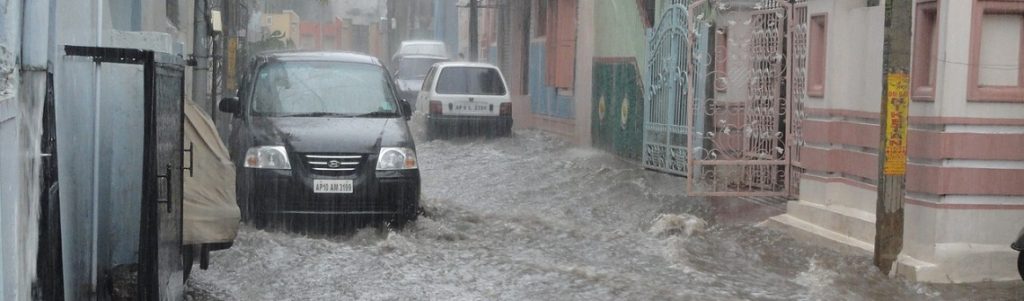
Flash floods are hydro-meteorological phenomena often responsible for dramatic consequences that are of a material, human and environmental nature. They are characterized by heavy rainfall which can be very localized, and the suddeness of the flow. For these reasons, they are very difficult to predict. Operational warning systems dedicated to flash floods have been recently developed in order to better forecast these phenomena and thus improve the alert issuance and reduce the consequences on the ground. This chapter presents various monitoring, forecasting and modeling tools which are currently used in order to capture the meteorological and hydrological phenomena responsible for such floods.In particular it focuses on ungauged basins where no direct observation is available, and the way in which the uncertainty appearing throughout the whole chain of warning issuance is taken into account.
Read this article from a comprehensive knowledge base, updated and supplemented with articles reviewed by scientific committees.
Read the articleAUTHOR
-
Pierre-Antoine VERSINI : Doctorate in hydrology from the École Nationale des Ponts et Chaussées (France) - Researcher at the Center for Applied Research in Hydrometeorology (CRAHI-UPC, Barcelona, Spain)
INTRODUCTION
Nîmes (1988), Vaison-la-Romaine (1992), Tarragona (1994), Biescas (1996), Corbières (1999), Algiers (2001), Gard (2002), Var (2010): in recent years, there have been numerous examples of intense rainfall events that have caused significant material and human damage. Certain images seen on television still haunt our memories, such as the caravan transported by the Ouvèze river which crashed into a bridge in Vaison-La-Romaine in 1992, or the torrents of mud that swept through the narrow streets of Draguignan in 2010, washing away everything in their path. These sudden, violent and often localized floods, also known as "flash floods", have been the focus of a great deal of work over the last ten years. Major efforts have been made to better understand and predict them, with the aim of improving warning systems and limiting their material, human and environmental consequences. To this end, scientific research organizations are working in conjunction with forecasting and emergency services to offer operational tools tailored to users and incorporating the latest advances in hydrometeorological research.
The aim of this article is to provide an overview of operational warning systems dedicated to flash floods. It presents the various observation, forecasting and modeling tools and methods – and their limitations – that are currently used to better understand the meteorological and hydrological phenomena responsible for such floods. As flash floods often occur downstream of small watersheds lacking instrumentation (rainfall and flow), particular attention will be paid to how this lack of direct observation can be overcome to provide useful and relevant flood warnings. These tools and methods, and the way in which they are combined, will be illustrated through concrete examples of existing operational tools. Finally, we'll show how the uncertainty that arises throughout the operational chain of warning production is taken into account, and what avenues can be pursued to improve both the reliability and timeliness of these warnings in the years to come.

Exclusive to subscribers. 97% yet to be discovered!
Already subscribed? Log in!
KEYWORDS
flash flood | forecasting system | flood warning | hydrology |
Early alert systems for sudden flooding
 Background information
Article included in this offer
"Safety and risk management"
(
463 articles
)
Updated and enriched with articles validated by our scientific committees
A set of exclusive tools to complement the resources
Bibliography
Exclusive to subscribers. 97% yet to be discovered!
Already subscribed? Log in!