Overview
Read this article from a comprehensive knowledge base, updated and supplemented with articles reviewed by scientific committees.
Read the articleAUTHOR
-
Claude PELLETIER : Former head of technical studies at PPM
INTRODUCTION
Within the already vast family of lifting equipment, mobile loading cranes represent a category of equipment that is broken down into a number of specific machine types corresponding to the various jobs for which they are intended.
However, all these machines have certain features in common. They are made up of a base structure containing the components required for mobility and stability. This basic structure supports an upper structure which houses the handling jib and the elements for load handling functions: lifting, raising, and possibly slewing when this upper structure pivots around a vertical axis in relation to the chassis, and telescoping when the jib is of variable length during operation (figure 1 ).
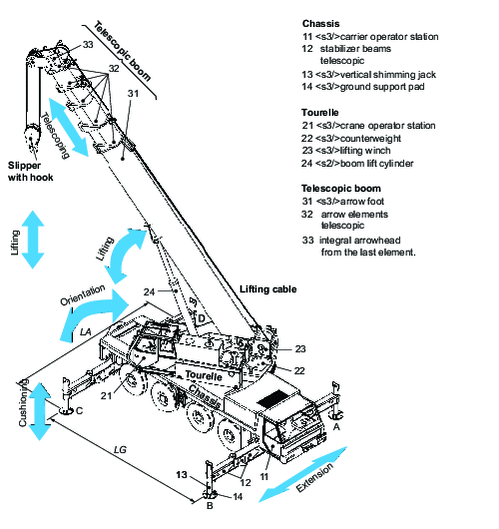
Lifting is the main motion of mobile cranes, but with the evolution of equipment, which is required to deliver ever higher performance, greater mobility, shorter set-up times and faster, more precise load movements, the variable-length telescopic boom has become another important function of mobile cranes.
These machines are designed to move loads in space using the functions described above. Load movements are limited by the machine's stability and the strength of its components, so that working safety is guaranteed at all times, in compliance with current regulations and taking into account environmental conditions.
Mobile cranes are capable of handling practically all existing products, within the limits of their capacities, i.e. it is sometimes necessary, if the handling conditions are known in advance, to size the packages according to the crane's capacities or, if not, to find one with higher capacities if the packages...

Exclusive to subscribers. 97% yet to be discovered!
Already subscribed? Log in!
Mobile loading cranes
 General design
Article included in this offer
"Logistics and Supply Chain"
(
104 articles
)
Updated and enriched with articles validated by our scientific committees
A set of exclusive tools to complement the resources
Standardization
European standards (EN)
- Appareils de levage à charge suspendue - Grues mobiles. - NF EN 13000 - 11-1997
International standards (ISO)
- Grues et appareils de levage - Classification - Partie 1 : Généralités. - ISO 4301-1 - 6-1986
- Grues et appareils de levage - Classification - Partie 2 : Grues...
Exclusive to subscribers. 97% yet to be discovered!
Already subscribed? Log in!